Static and Dynamic Websites

Static Websites

In the early days of the Web, almost all Web sites were what is known as 'static sites.' Content (text, images, video, audio, etc), was placed or embedded in a file in which HTML tags were used to format it. If you looked at the actual contents of the file, you might see something like this:

image

The content and the tags lived side-by-side. To edit the page, you’d open up the file (on your own computer) in a program capable of editing HTML files and make changes to either the content or the presentation. Every page had to be edited individually, even if the edits you were making were for common elements that appeared on many pages (like menu bars).

From a technical perspective, accessing a static Web site is fairly straightforward. When your computer is connected to the Internet, you can use a Web browser to access files on a Web server (as long as you know the address). The Web server delivers the contents of those files to your browser, and your browser displays them.

Dynamic Websites

Over time, as the Web became more sophisticated, new systems emerged for creating and managing Web sites. These moved beyond the model of having content and HTML tags live in a simple HTML page which your browser accessed and displayed. Instead, these systems were Web applications – software that literally runs on the Web server and makes it possible to manage a Web site, often with very sophisticated features. One feature of these applications is that they separate content and presentation by storing most content (your text, images, etc) and data about the site (the title, options, etc). in a database.

On the Web server, the Web application installs files that are written in some kind of programming language. The server reads this code and obeys any requests in it to access data in the database (which lives on a separate server) and displays it according to the instructions in the code.

image

Essentially, the data for the site (living in a series of tables in a database on the database server) is entirely separate from the actual presentation of the site (living in the code of the programmed files on the Web server). Special software on both the Web server and the Database server enable the two to speak to each other and work together.

One of the benefits of using a Web application is that you usually don’t need to touch (or even look at!) the code in order to make changes to your content. In addition, editing the site usually involves accessing some kind of control panel through your Web browser and filling out a form, instead of having to download and access files in software on your own computer.

Dynamic vs Static Content

Sometimes when we talk about the difference between dynamic and static content we get bogged down in the idea of whether or not the content is “fresh” (dynamic, regularly updated) or “old” (static, never updated). How frequently you update your content has nothing to do with what kind of system you are using to manage your site. You can manage a static Web site (as described above) and update the content every day. You can also have a dynamic Web site (running something like WordPress) and never change the content after you create it.

Generally speaking, it IS easier to regularly update content on a dynamic Web site because the Web application just makes it easier. Sometimes, even when you just want a very basic page or placeholder, it’s easier to install a Web application (and only put up a single page) then to manually create an HTML page and upload it.

A Side Note about Separating Content from Presentation: Style Sheets

Another aspect of separating content from presentation involves the use of 'Cascading Style Sheets' (CSS). These are special files that live on your Web server and are linked to your Web pages. They contain information (written in a special markup language) about how to make elements on your site look. They allow you, for example, to define in a single location what all Level 1 Headings look like on your site. They are an important aspect of understanding how to separate content from presentation, but they’re not really an aspect of the difference between static and dynamic sites. Both static and dynamic sites can use style sheets.
LAMP Environments

When you sign up for domains.skidmore.edu, you get space on a Web host that is associated with the project. There are a few things you need to know about the Web host that will make it easier to understand what you can do with your new space.

The Web Server

The Web server is the main computer that is associated with the domains.skidmore.edu hosting account. It’s literally a computer, but it’s a computer that has special software on it that allows it to be accessible via the Web. The files that run your applications, images or video you upload, or any other files you upload into your Web space are stored on this server.

(For comparison’s sake, your desktop or laptop computer, by default, doesn’t allow this; I can’t access files on your computer through a Web browser by default. You CAN actually install Web server software on your own computer, essentially making your files accessible over the Web.)

In order to run, a Web server has an operating system installed and some kind of Web server software. The domains.skidmore.edu server runs the 'LINUX' operating system and an 'APACHE' Web server.

The Database Server

In addition to the Web server, there is also an associated database server. This is another computer, but it is configured with software that allows it to host databases. It is also connected to your Web server so that your applications (hosted on the Web server) can retrieve data (from databases hosted on the database server).

Databases come in LOTS of varieties. The kind of database you can use for a Web application depends on the kind of software that’s installed on the database server. The domains.skidmore.edu server can run 'MYSQL' databases.

The Programming Language

When you install open-source software on your Web account, it’s going to be written in some programming language. Your Web server has software installed on it that allows it to understand different languages. If you install software that’s written in a language that your Web server doesn’t read, it won’t work.

The domains.skidmore.edu server has software installed on it that allows it to understand 'PHP''PERL', and 'PYTHON'.

Add it Together: LAMP

If you take a look at all the descriptions above, you can determine that we are running what is known as a LAMP server for create.ou.edu:

  • Linux (operating system)
  • Apache (Web server)
  • MySQL (database server)
  • PHP/PERL/PYTHON (programming language)

Applications that are written for LAMP environments will, presumably, run on the server. HOWEVER, some applications do require additional extensions or libraries that aren’t included, by default, in a LAMP environment. The applications you can install via Installatron (in cPanel) should work just fine.

What makes LAMP environments special is that all of the component parts are open-source. Linux, Apache, MySQL, PHP, PERL, and PYTHON are all open-source programs or systems. Anyone can download them (for free) and install them. Anyone can also modify them and redistribute them. As a result, there are lots of online resources for using these systems that have been built by their communities of users. But, also as a result, since you’re not paying for these systems, you can’t just call up a company and ask them to fix a problem.

Video Resource

You may find this video, which explains how the LAMP technology stack works, useful in further understanding LAMP Web environments.

What are the technical requirements/limitations of Skidmore Domains?

Skidmore Domains uses a kind of Web server knowns as a LAMP server. “LAMP” is an acronym for the technology stack that is installed on the server:

  • Linux: This is the open-source operating system that is used on the server.
  • Apache: This is the Web server software that the server uses.
  • MySQL: This is the database software that the server uses.
  • Php/Perl/Python: These are the three programming languages that the server can interpret.

Generally, if you are using applications available to install by default through the domains.skidmore.edu server, you shouldn’t need to worry about these technical details. All of the software that is available for installation (in cPanel) meets the technical requirements.

If you’re interested in finding/installing another application (that isn’t available through our automatic installer tool), then you’ll have to be sure that the server can support it. To start with, you’ll want to be sure that the Web application can run on a LAMP server. Check the technical requirements for the application to determine this. You’ll also need to do some research about whether there are any additional services or modules required on the server. Some software may require components that aren’t included in the default installation of the LAMP stack. In that case, contact us with details about what you need, and we’ll see what we can do.

Social Media

As you begin to build out your digital presence you’ll probably start to think about social media in some form. In fact it’s likely that you already have at least one, if not more, social media accounts (Facebook being the most popular to date). Everyone uses social media in different ways, and although it’s often interesting to see people break the boundaries of the “social norms” of a specific online community, this article will focus more on the accepted use cases for specific social networks and how they can help you build your digital presence. This is by no means a comprehensive “How To” of Twitter or Facebook, but a good starting guide to think about where you best fit in to these online communities.

Facebook

The majority of folks that will read this likely have a Facebook account. With over 1 billion active users it’s by far one of the more popular social networks. Many treat Facebook as a semi-personal space, one reserved for family and friends to share photos and highlights of what’s happening in their lives. Facebook also supports “Groups” for sharing amongst a smaller set of individuals regularly, and “Pages” which are less personal and more public-facing profiles meant for organizations and businesses. There are plenty of applications that make it easy to publish a link to the work you do on your blog and your participation in other networks back into your Facebook profile. In general it’s a good practice and can often lead to interesting conversations with different groups of folks. This practice of publishing elsewhere and then feeding into Facebook is desired over the alternative, using Facebook for all content and then pushing it out to other communities. The main reason for this is that privacy concerns over how different people can view content on Facebook have changed often enough to leave users concerned. There’s also never any certainty of sustainability with any of these social networks (remember MySpace or Friendster?) no matter how popular, so publishing in your own space and then pushing out to others makes a lot of sense. The key takeaway is that Facebook is a great personal network and can also be the starting point for some of these larger professional discussions should you decide to use it that way.

Twitter

While no longer the new kid on the block, Twitter has only relatively recently started to gain momentum. It doesn’t have nearly the same user base as Facebook (though there are about 500 million accounts to date) and the way people use it is very different. Twitter has focused on the short status message from the start, before Facebook even integrated the idea into their platform. Users are limited to 140 characters. It’s a conversational platform for interacting with people. It’s used heavily at conferences and many choose this as a social network for really networking with peers and others in their community as well as people they might not ever meet in real life. You can follow as many people as you want and it’s a great way of having a stream of information about “what’s happening” with people and groups you’re interested in. One powerful development of Twitter is that celebrities have begun to embrace it as a way to speak directly to their fans without having the message interpreted through other media and journalism with a slant. The ability to search various topics or hashtags (keywords) and see a running stream of what people are saying about that topic is also a very powerful way of gauging reaction to ideas and events. It’s a great idea to experiment with a Twitter account by signing up, adding a profile picture and information about yourself, following a group of people, and interacting with it daily. While the gratification may not be immediate, it’s one of those social networks where the more you put into it the more you will get out of it.

LinkedIn

LinkedIn is the professional resumé of social networks. It mixes the ability to keep an updated resume of where you work and what your accomplishments are with a social aspect of having people recommend you and comment on your work. Most users find LinkedIn helpful not as a day-to-day network they use, but rather when they’re searching for a new job and want to find people they know that might have connections. The old saying “It’s who you know” when finding a job or making a connection is particularly relevant here where those connections can be exposed to you (You know this person who works for the company of one of Bill Gate’s sons, and the VP went to high school with you).

Summary

As mentioned in the opening paragraph, talking about social media is an ever-changing and moving target and this article can never be truly comprehensive. The goal of domains.skidmore.edu is to have you thinking more critically about where you put your content, not that you don’t participate in these networks which still have a lot of value, but rather that you own the work you create. Facebook, Twitter, LinkedIn, and others all have different audiences and the more places you push your content to, the more opportunities for discussion and feedback you’ll receive. The ability to network with an increased amount of people that isn’t reliant on face-to-face meetings is a powerful change in how we interact on the web and the value of it. As you begin to explore social media the best recommendation would be to choose a space you want to explore and really dive in. Follow as many people as possible, talk to them, respond to their work, and you’re more likely to get responses in return that start to build that sense of community for you.

DokuWiki

DokuWiki is a standards compliant, simple to use wiki, mainly aimed at creating documentation of any kind. It can be used as an encyclopedia of knowledge or resources, for outlining projects, or to draft documents. Some of the features it includes are:

  • Simple syntax
  • Unlimited page revisions
  • Track recent changes
  • Colored side by side diff support
  • Uploading and embedding of images and other media
  • Content can be categorized in namespaces, easily browsable through an automatic index
  • Straightforward configuration
  • Section Editing allows editing of small parts of a page
  • Toolbar and access keys make editing easy for both beginners and professional
  • Easy navigation through breadcrumbs
  • Automatic table of contents generation
  • Locking to avoid edit conflicts
  • Automatic save to avoid content lost during editing
  • Extended Access Control Lists
  • Support for over 50 languages

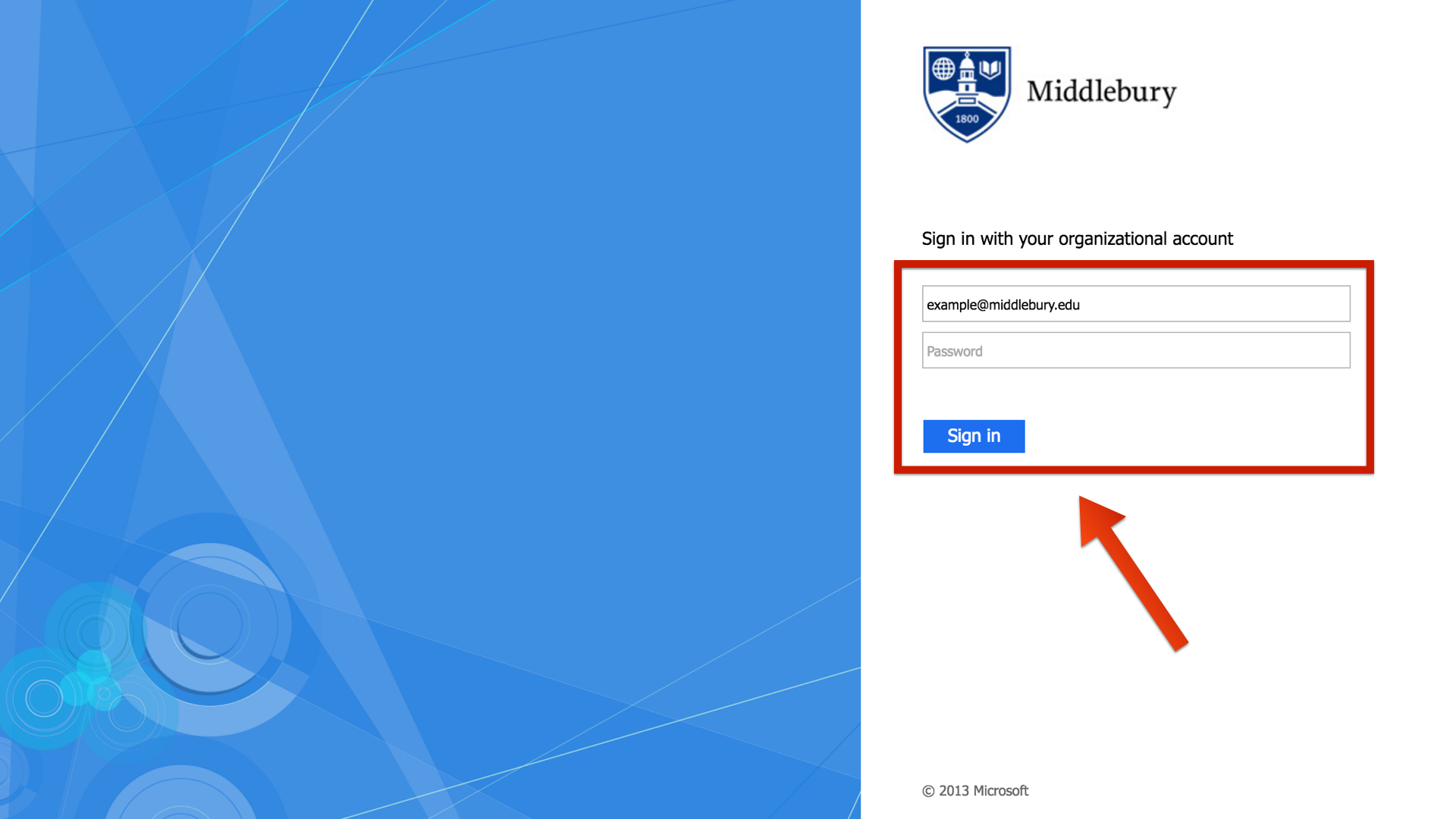
1. To get started you’ll need to log in to your control panel (https://domains.skidmore.edu/dashboard) using your Skidmore username and password.

sign in.001

2. Once logged in you’ll be at the homepage of your control panel. Navigate to the Installatron by looking under the ‘Software’ section or typing “Installatron” into the search bar at the upper right corner of the page.

installatron new.001

3. Click on the Applications Browser tab (the one with the star). Then select DokuWiki under the ‘Apps for Content Management’ section.

dokuwiki

4. This page gives you more information about the DokuWiki software. To begin the install, click ‘install this application’ in the upper right-hand corner.

dokuwiki1

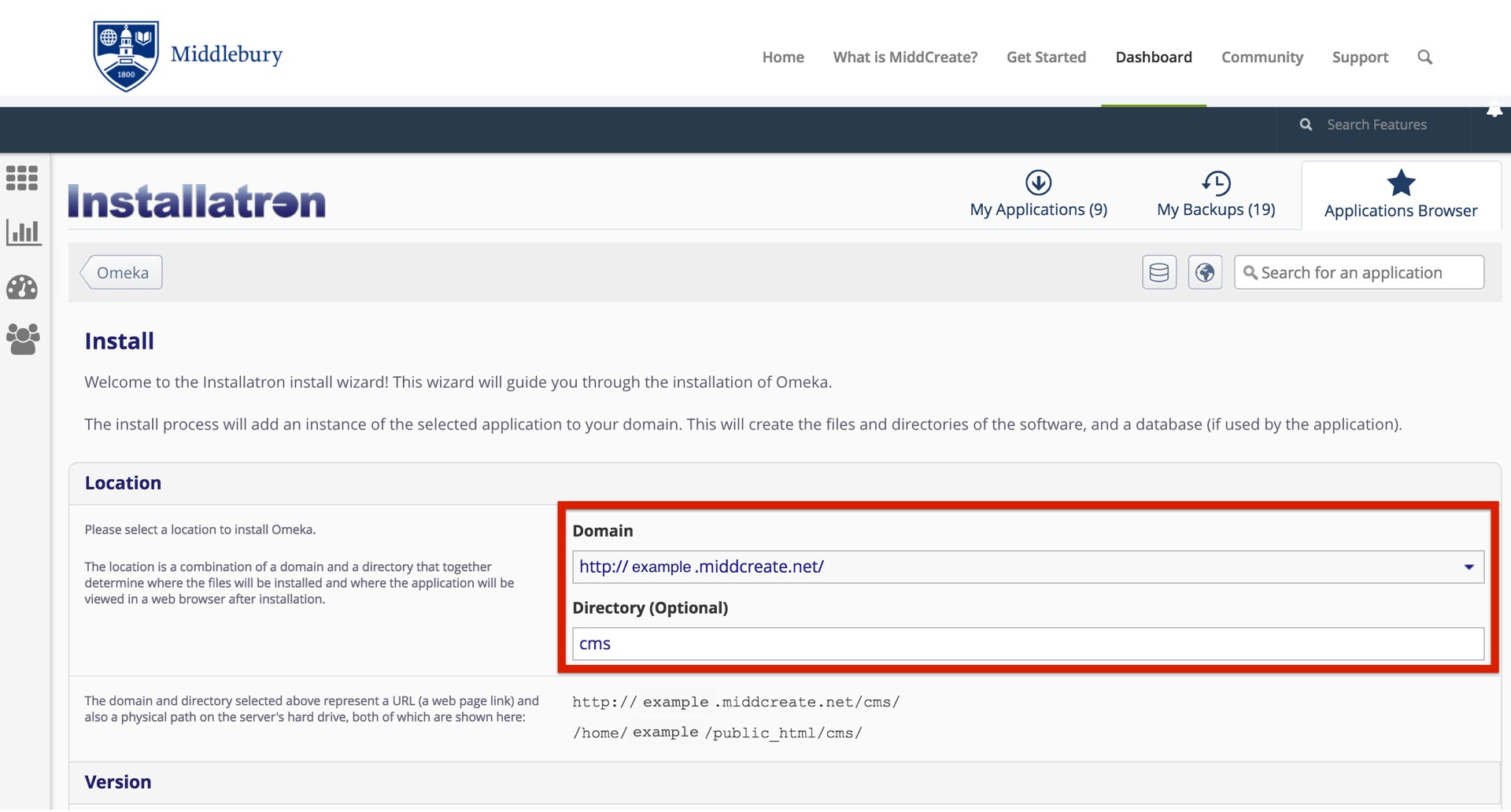
5. On the next page the installer will ask for some information about this install. The first thing you’ll want to do is decide where to install it. If you’re wanting to install DokuWiki on your main domain, you can leave the directory area empty. If you created a subdomain, you can select it from the dropdown menu. You also have the option of installing DokuWiki in a subfolder by typing in the folder name in the Directory field. Click here for more information about subdomains and subfolders.

install omeka.001

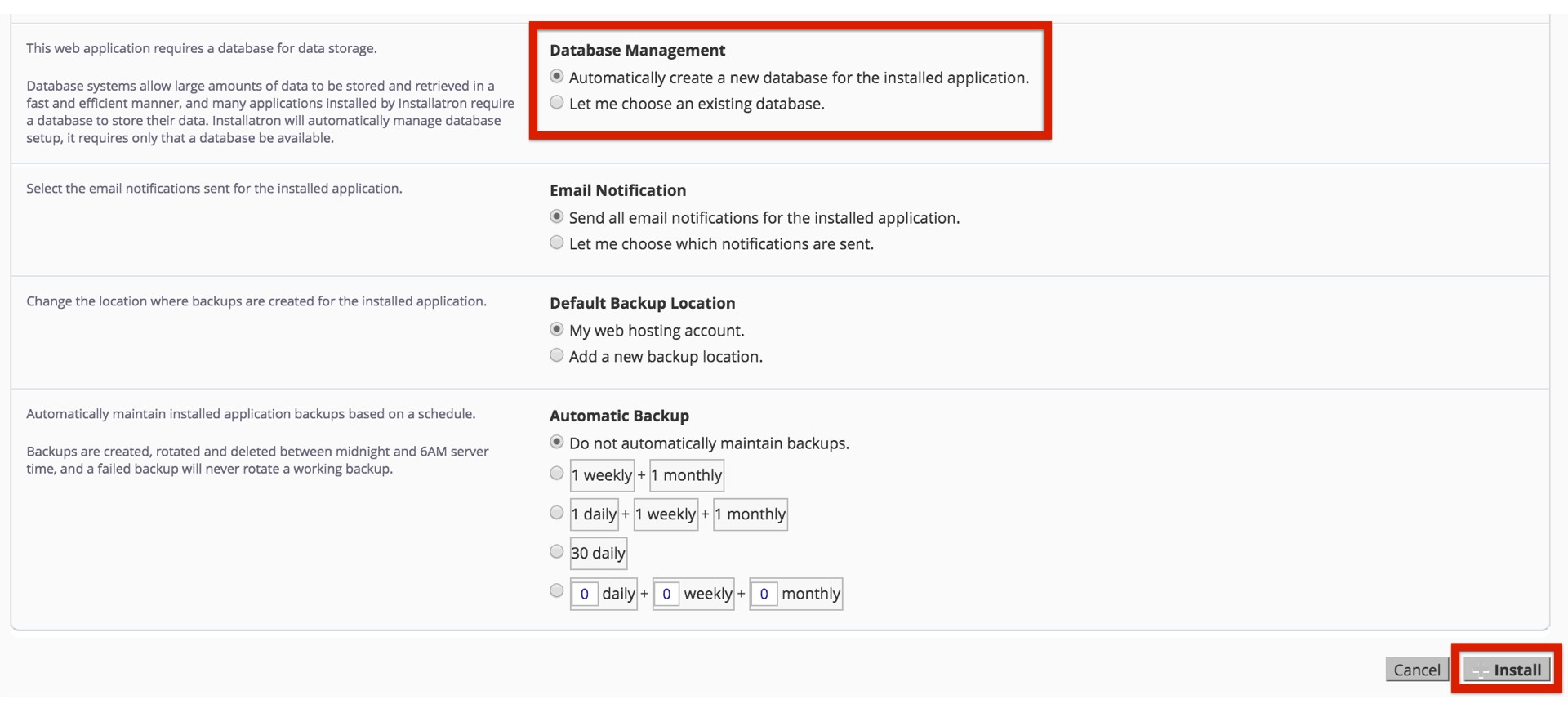
6. By default the installer will automatically backup your website and update it anytime a new version comes out. While we recommend you keep this option, it is possible to only do minor updates, or turn them off completely. The installer will also create a database for you automatically, but if you’ve already created one for this website you can choose Let me manage the database settings and enter the details. Click Install to continue. omeka database.001

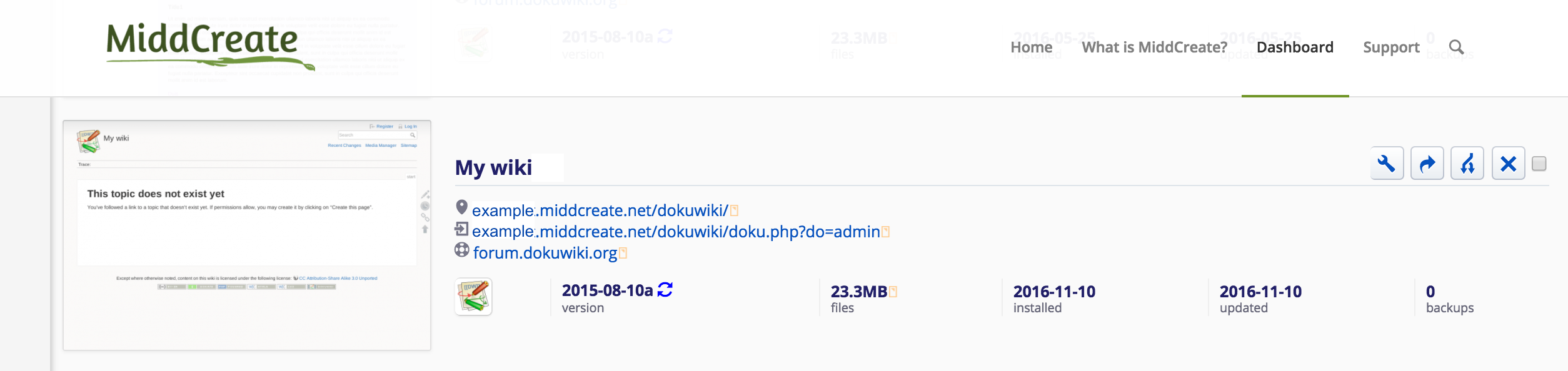
7. The installer will take just a few moments to install DokuWiki and a progress bar will keep you updated. When it is complete you will see links to your new DokuWiki site.

dokuwiki3

8. Congratulations, you have now completed the installation of DokuWiki! Click the top link to log in to your DokuWiki installation.

Using DokuWiki

You can learn how to use this application in the official DokuWiki User Manual, including how to write in wiki syntax when editing pages. These manuals will help you get started and begin building your DokuWiki.

Known

Known is a social publishing platform that combines aspects of blogging and social media. It’s very easy to use and works like a Facebook group or Tumblr.  You can invite up to 200 users to collaborate by sharing posts, status updates, photos, and audio.  You can also make your own events or RSVP to external events. Known integrates with a number of social networks. When you publish on Known, you can choose to syndicate your content to a variety of sites like Facebook, Twitter, LinkedIn, Flickr, Soundcloud, and more. It also has the following features:

  • Use hashtags with any content to categorize and organize what you publish
  • Privacy settings that let you make posts or the whole site public, private, or for members only
  • View, edit, and post from any device (tablets, smartphones, etc.)
  • Import posts from a WordPress site

1. To get started you’ll need to log in to your control panel (https://domains.skidmore.edu/dashboard) using your Skidmore username and password.

sign in.001

2. Once logged in you’ll be at the homepage of your control panel. Navigate to the Installatron by looking under the ‘Software’ section or typing “Installatron” into the search bar at the upper right corner of the page.

installatron new.001

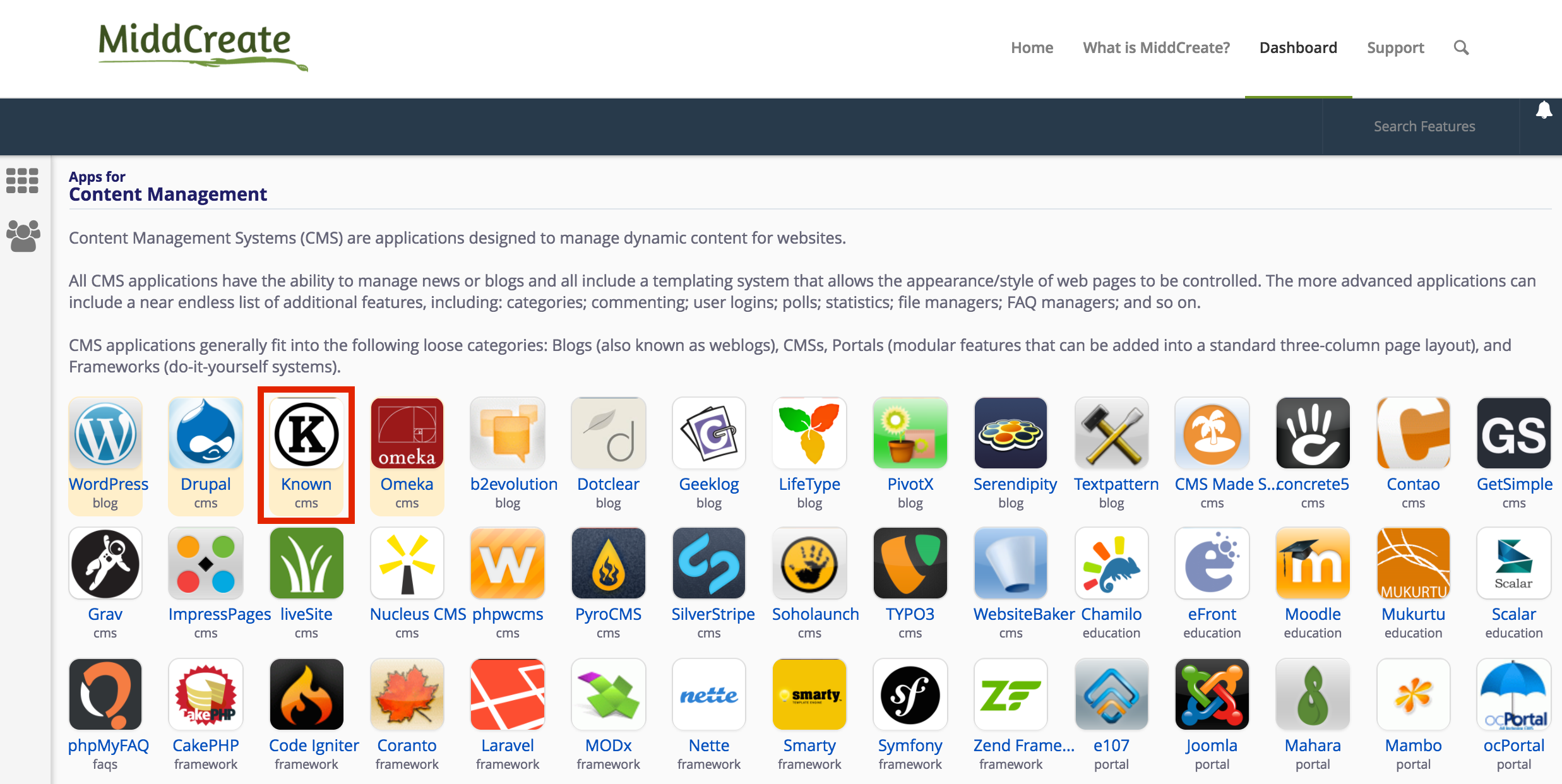
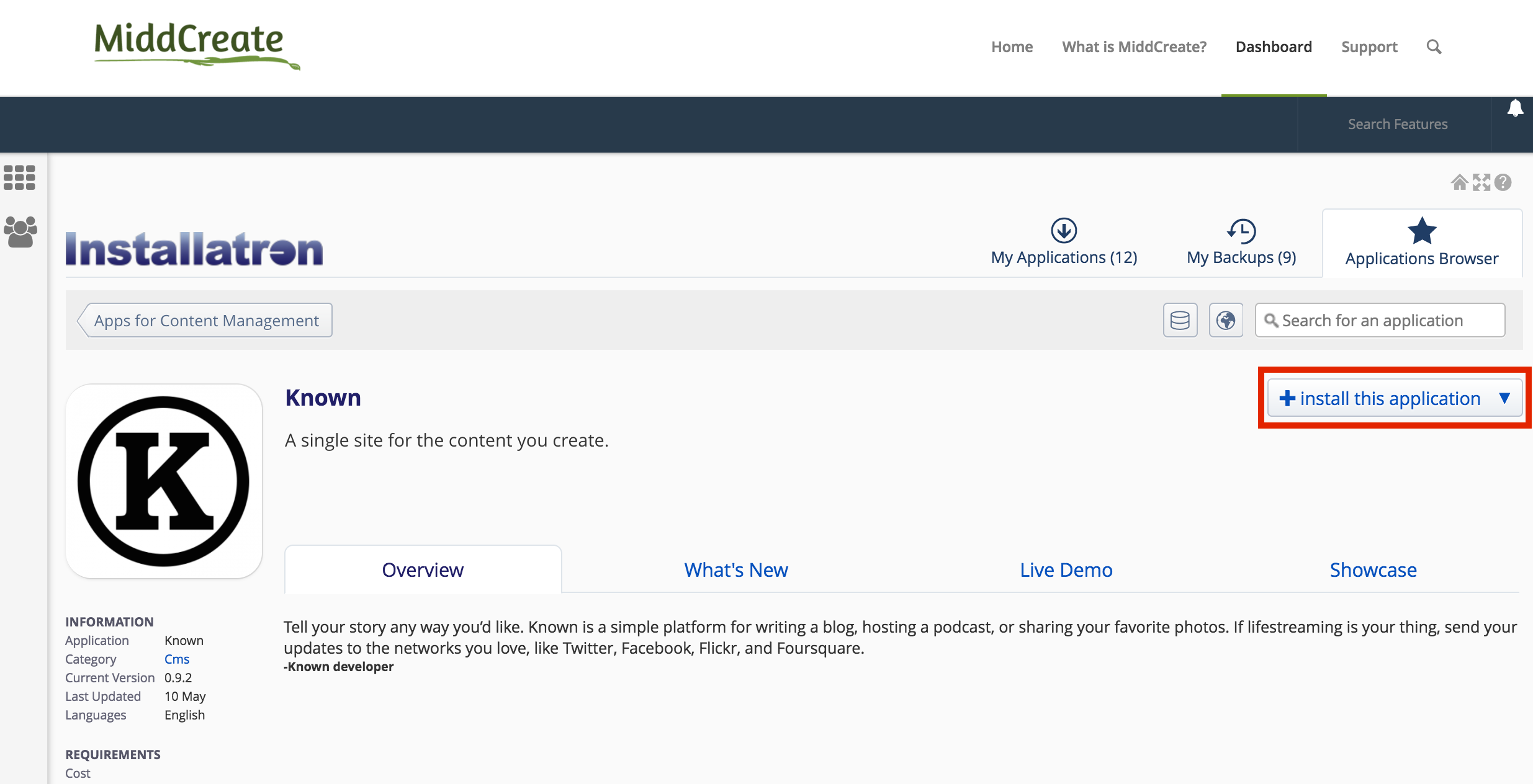
3. Click on the Applications Browser tab (the one with the star). Then select Known under the ‘Apps for Content Management’ section.

known

4. This page gives you more information about the Known software. In order to connect Known to your social media accounts, you will need to install it on a subdomain. Before you proceed with this installation, first create a new subdomain. Once you have set up the subdomain, you can install Known by clicking ‘install this application’ in the upper right-hand corner.

known2

5. On the next page the installer will ask for some information about this install. Select the subdomain you created from the dropdown menu. You also have the option of installing Known in a subfolder by typing in the folder name in the Directory field. Click here for more information about subdomains and subfolders.

install omeka.001

6. By default the installer will automatically backup your website and update it anytime a new version comes out. While we recommend you keep this option, it is possible to only do minor updates, or turn them off completely. The installer will also create a database for you automatically, but if you’ve already created one for this website you can choose Let me manage the database settings and enter the details. Click Install to continue. omeka database.001

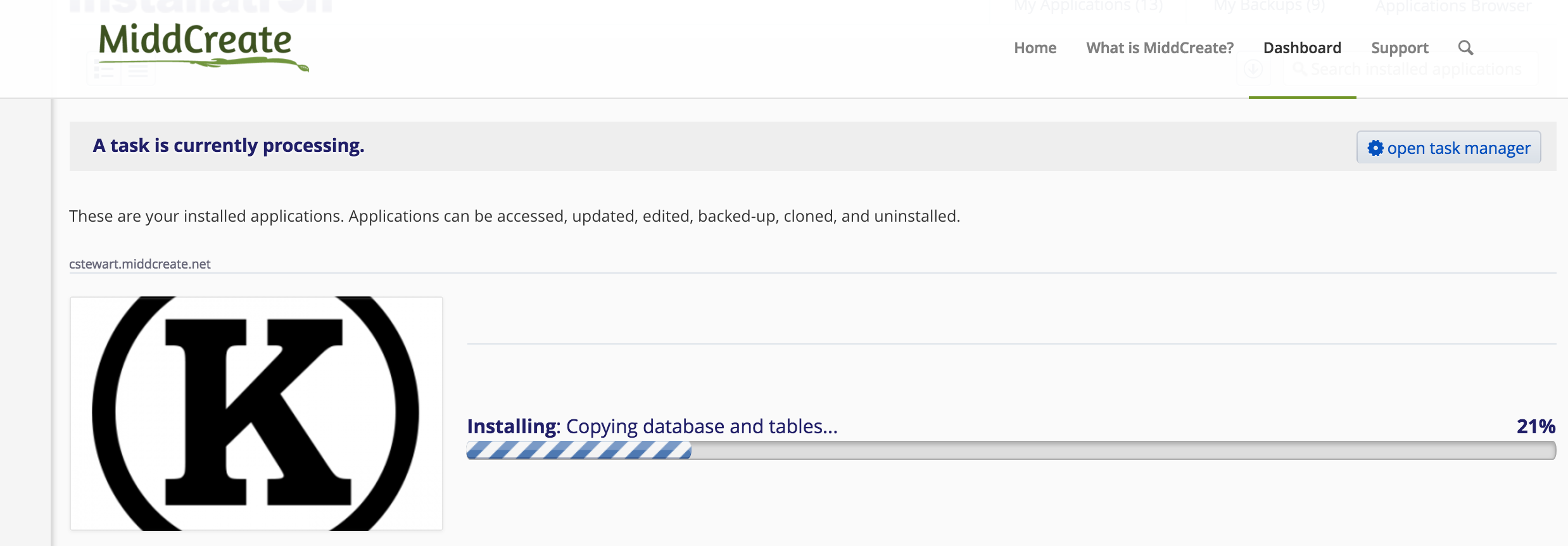
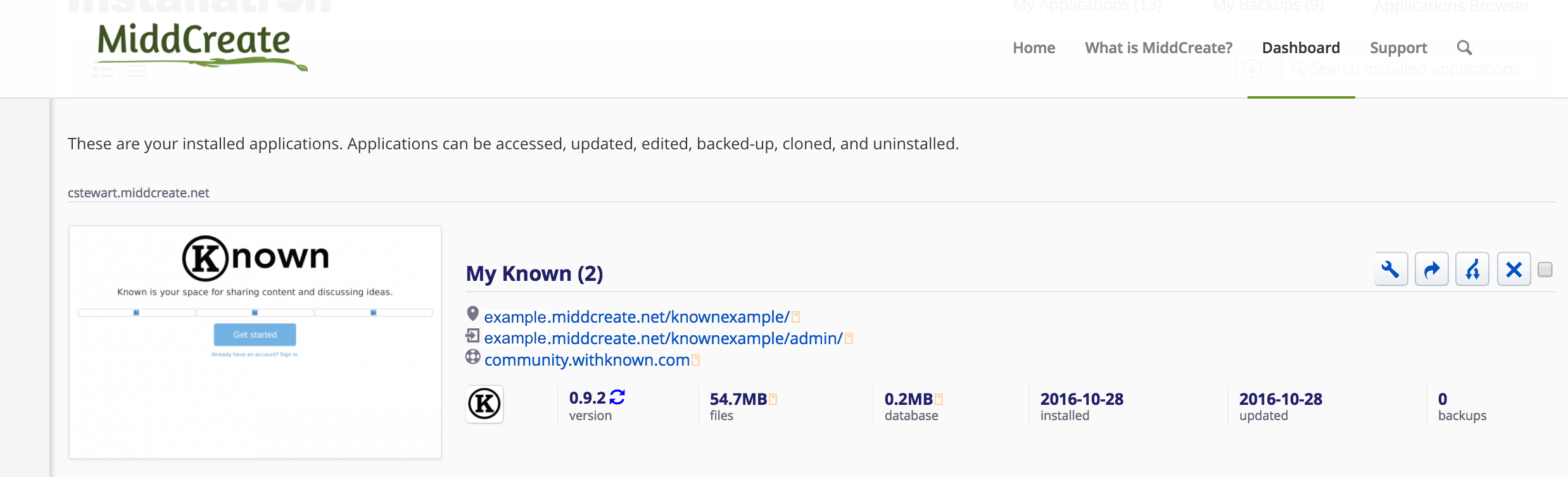
7. The installer will take just a few moments to install Known and a progress bar will keep you updated. When it is complete you will see a link to your new Known site as well as a link to the backend administrative section of the site.

knownprogress

knownlinks

8. Congratulations, you have now completed the installation of Known! Click the second link to log in to your Known site.

Using Known

You can learn how to use this application in the official Known Guides. These support guides will help you get started and begin posting content on your Known.

Scalar

Scalar is a free, open source authoring and publishing platform that’s designed to make it easy for authors to write long-form, born-digital scholarship online. Scalar enables users to assemble media from multiple sources and juxtapose them with their own writing in a variety of ways, with minimal technical expertise required. More fundamentally, Scalar is a semantic web authoring tool that brings a considered balance between standardization and structural flexibility to all kinds of material.

Scalar also features a built-in open API that allows you blend your Scalar content with other data sources, build your own visualizations, or create completely new interfaces for your materials. You can see some custom designed Scalar sites on this Skidmore Domains Apps Showcase site.

1. To get started you’ll need to log in to your control panel (https://domains.skidmore.edu/dashboard) using your Skidmore username and password.

sign in.001

2. Once logged in you’ll be at the homepage of your control panel. Navigate to the Installatron by looking under the ‘Software’ section or typing “Installatron” into the search bar at the upper right corner of the page.

installatron new.001

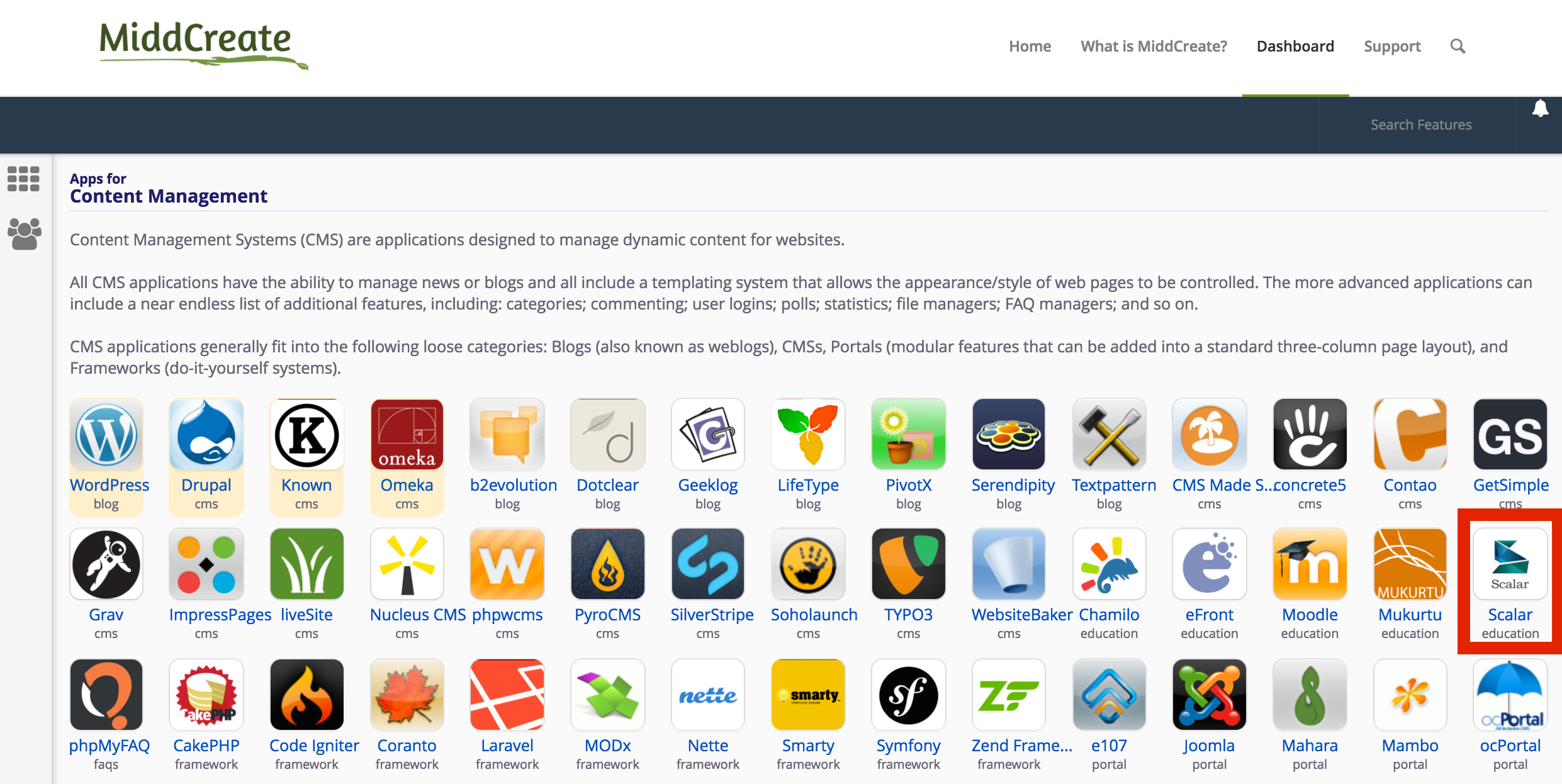
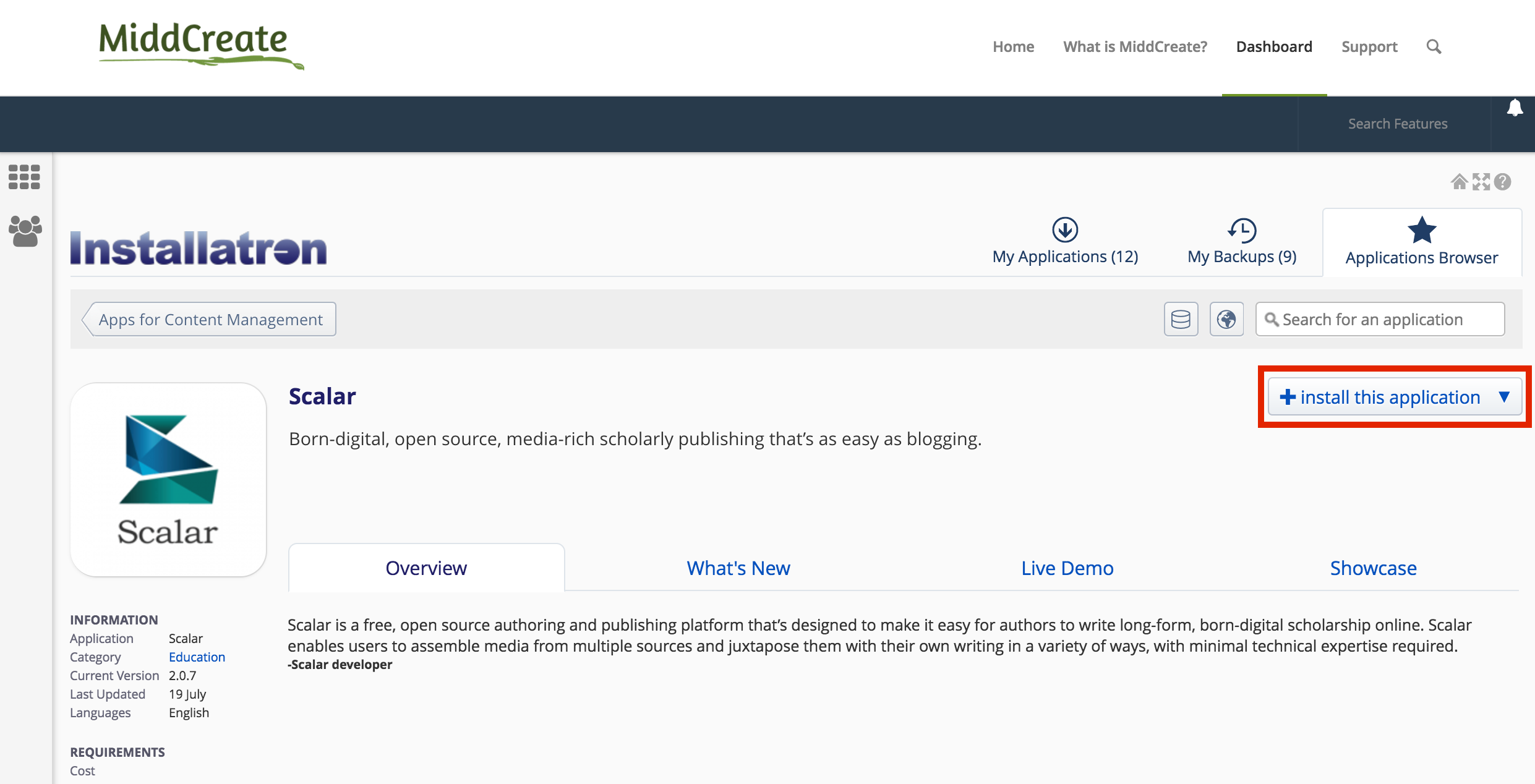
3. Click on the Applications Browser tab (the one with the star). Then select Scalar under the ‘Apps for Content Management’ section.

scalar

4. This page gives you more information about the Scalar software. To begin the install, click ‘install this application’ in the upper right-hand corner.

scalarinfo

5. On the next page the installer will ask for some information about this install. The first thing you’ll want to do is decide where to install it. If you’re wanting to install Scalar on your main domain, you can leave the directory area empty. If you created a subdomain, you can select it from the dropdown menu. You also have the option of installing Scalar in a subfolder by typing in the folder name in the Directory field. Click here for more information about subdomains and subfolders.

install omeka.001

6. By default the installer will automatically backup your website and update it anytime a new version comes out. While we recommend you keep this option, it is possible to only do minor updates, or turn them off completely. The installer will also create a database for you automatically, but if you’ve already created one for this website you can choose Let me manage the database settings and enter the details. Click Install to continue. omeka database.001

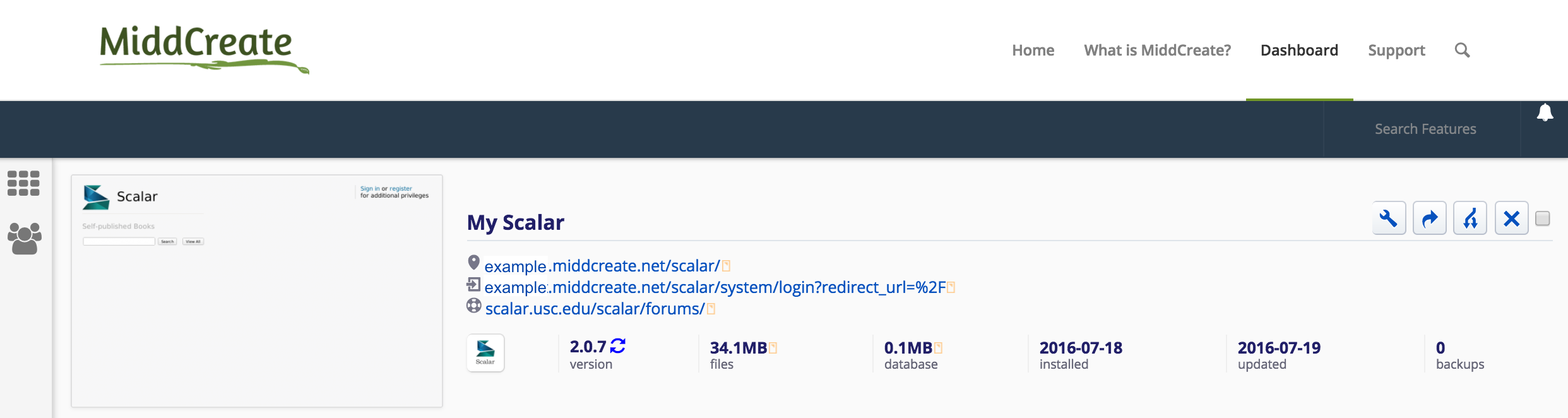
7. The installer will take just a few moments to install Scalar and a progress bar will keep you updated. When it is complete you will see links to your new Scalar site.

scalarlinks

8. Congratulations, you have now completed the installation of Scalar! Click the top link to log in to your Scalar installation.

Using Scalar

You can learn how to use this application in the official Scalar 2 User Guide or Scalar 1 User Guide depending on which format version you choose. These support guides will help you get started and begin publishing with Scalar.

LimeSurvey

LimeSurvey is a survey making tool that allows you to easily create and execute a variety of assessments. Some of the features available in this application are:

  • Unlimited number of surveys, questions, and participants
  • Multi-lingual surveys: 80 different languages supported
  • Surveys can be shared via a link, or you can send tokens so only specific users can access the survey
  • Send invitations and reminders by email
  • Ready-made importable questions & surveys
  • 28 different question types with more to come
  • Conditions for questions depending on earlier answers
  • Anonymous and non-anonymous surveys
  • Integrate pictures and movies into a survey
  • Printable versions of your survey

Installing LimeSurvey

1. To get started you’ll need to log in to your control panel (https://domains.skidmore.edu/dashboard) using your Skidmore username and password.

sign in.001

2. Once logged in you’ll be at the homepage of your control panel. Navigate to the Installatron by looking under the ‘Software’ section or typing “Installatron” into the search bar at the upper right corner of the page.

installatron new.001

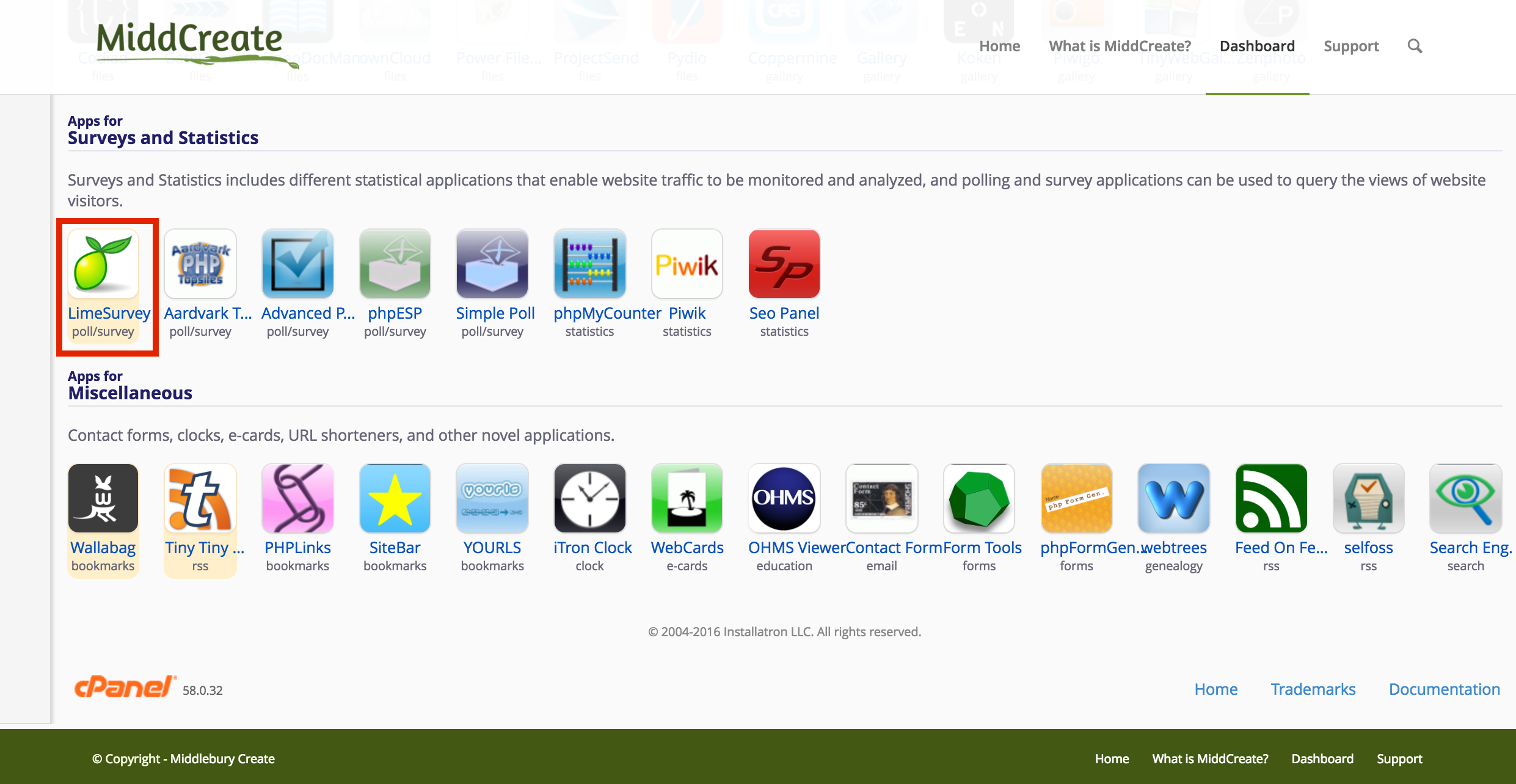
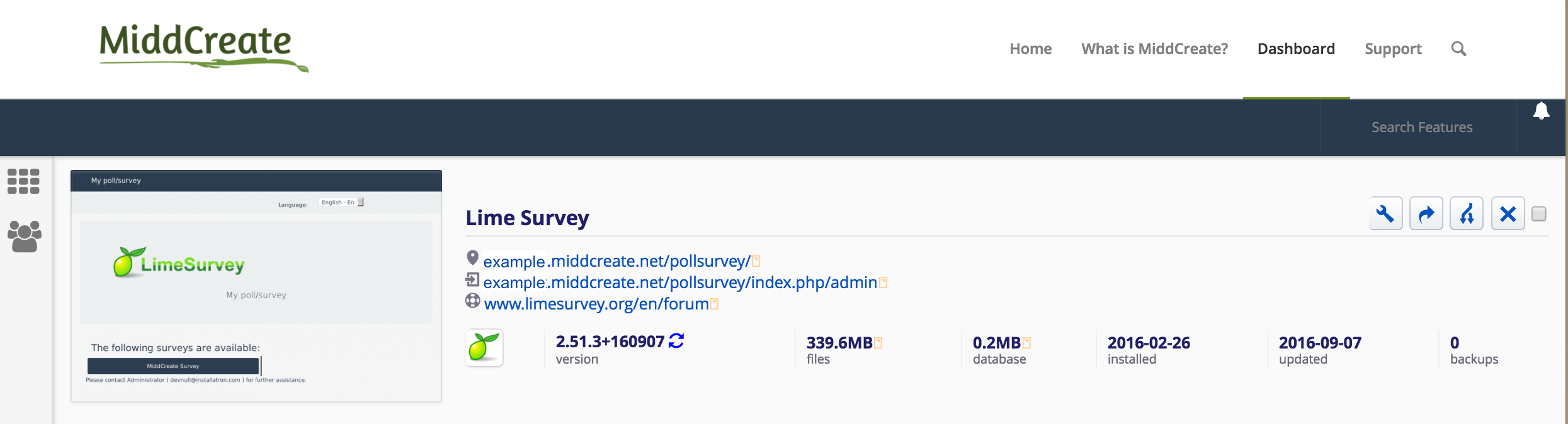
3. Click on the Applications Browser tab (the one with the star). Then select LimeSurvey under the ‘Apps for Surveys and Statistics’ section.

limesurvey

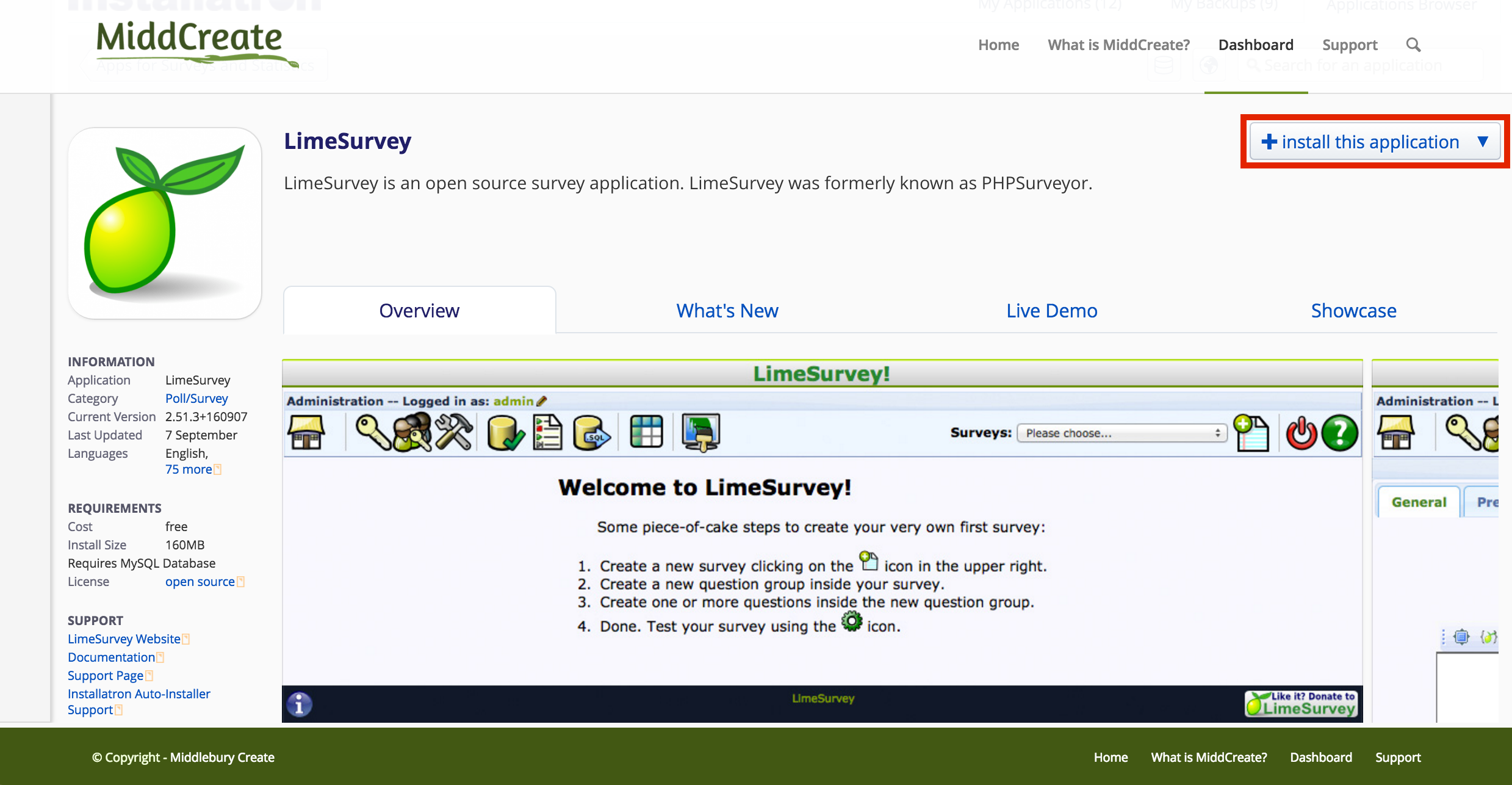
4. This page gives you more information about the LimeSurvey software. To begin the install, click ‘install this application’ in the upper right-hand corner.

lmsvy1


5. On the next page the installer will ask for some information about this install. The first thing you’ll want to do is decide where to install it. If you’re wanting to install LimeSurvey on your main domain, you can leave the directory area empty. If you created a subdomain, you can select it from the dropdown menu. You also have the option of installing LimeSurvey in a subfolder by typing in the folder name in the Directory field. Click here for more information about subdomains and subfolders.

install omeka.001

6. By default the installer will automatically backup your website and update it anytime a new version comes out. While we recommend you keep this option, it is possible to only do minor updates, or turn them off completely. The installer will also create a database for you automatically, but if you’ve already created one for this website you can choose Let me manage the database settings and enter the details. Click Install to continue. omeka database.001

7. The installer will take just a few moments to install LimeSurvey and a progress bar will keep you updated. When it is complete you will see a link to your new LimeSurvey site as well as a link to the backend administrative section below it.

limesvy2

8. Congratulations, you have now completed the installation of LimeSurvey! Click the administrative link to log in and begin creating surveys with your new LimeSurvey installation.

Using LimeSurvey

You can learn how to use this application in the official LimeSurvey Manual. This support documentation wiki can help you get started by showing you how to do the following:

E-commerce Applications

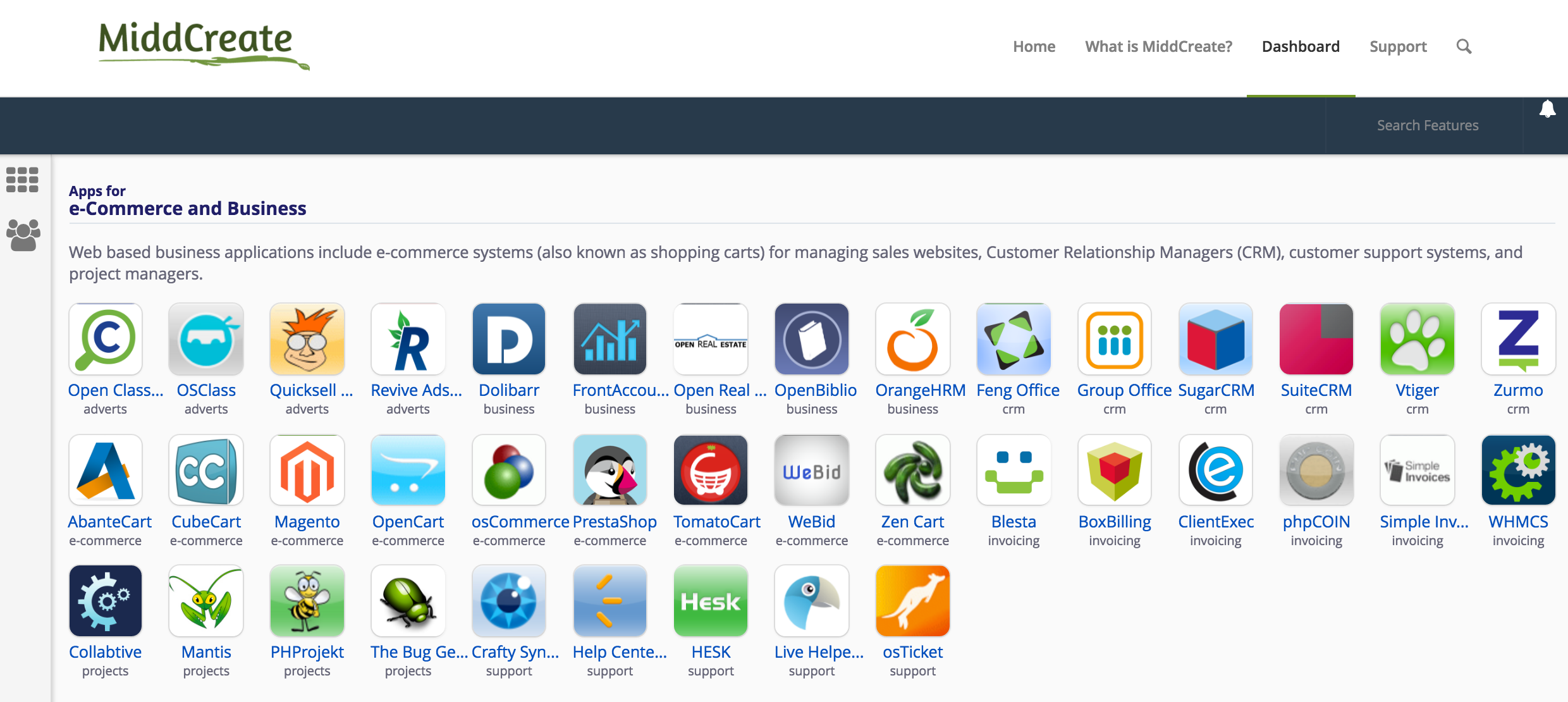
ecommerce

Skidmore Domains’s Installatron offers 9 e-commerce applications. However, members of the Skidmore College and Skidmore Institute of International Studies community are not allowed to utilize these applications to actually conduct sales or make money.

In Skidmore’s Web Policies under ‘Guidelines for All Web Pages’, section 1b, it states:

Unauthorized use of Skidmore College’s Web sites for commercial purposes is prohibited. Personal or institutional Web pages may not be used for direct advertising for personal profit or gain.

Under section 1d of the ‘Guidelines for Student Organization Sites, Personal Pages and Postings’, it further states that:

The College will review complaints, questions, and concerns regarding allegations of copyright infringement, misuse of intellectual property, harassment, use of College Web resources for commercial purposes, and other legal issues. If the complaint is valid, the College will contact the student organization’s Web editor and request immediate revision of the Web page and/or removal of inappropriate materials in compliance with College policies, intellectual property law, and guidelines for responsible use of computing resources. The College may shut down the Web site if there is inadequate or no response from the student organization. Illegal, irresponsible, or unethical activities may result in loss of privileges or penalties consistent with the judicial procedures and policies of the College.
E-commerce applications remain available in the Installatron solely for educational purposes, so that students, faculty, and staff can explore them in order to expand their knowledge of digital tools. Please feel free to install and experiment with them on your domain, but be aware that inappropriate usage could lead to a request to desist or result in your site being shut down.

Backup Wizard

The cPanel has a Backup Wizard that lets you easily backup and restore all or parts of your domain files and databases.

  1. Login to domains.skidmore.edu.
  2. In the Search Box at the top of the page, search for “Backup Wizard”, or under Files click on Backup Wizard.
Skidmore Domains docs edits.001

backup wizard

3. If you click the “Backup” button, you will have the option to create a full or partial backup. A full backup will create an archive of all the files and configurations on your website. You can only use this to move your account to another server, or to keep a local copy of your files. You can’t restore full backups through your cPanel interface. In order to restore files, you’ll need to download partial backups.